I wrote this piece for my college magazine...always been interested in molecular biology!
Yep. It’s kind of hard to engineer a protein (restriction-endonuclease) to bind to the exact DNA sequence we want, AND then have it cut that very sequence. Sometimes you get a protein which binds well but won’t cut, and vice versa.
Genetics. An art, rooted firmly in science. The mysteries
behind it unraveled slowly, starting with our ancestors, who discovered that
certain traits bred true, and that traits could be combined through a process
of careful selection and artificial breeding. Today, genetic engineering
techniques allow us to create microscopic protein factories. Clearly, genetics
is a cornerstone of biology.
There’s always been something missing though. Genetic
engineering techniques never managed to give us complete control. You could
finally manage to breed a white tiger, and then the recessive alleles would
pair up and give it a bunch of diseases, and you’re back to square one. Maybe
you managed to breed a dog with a nice color of fur, but it has stumpy legs! Some
unwanted traits have always crept in. Maybe the genes you want show linkage
with genes you don’t want. Plus, modifying eukaryotic genes has been a hurdle,
because traditional vectors like plasmids don’t work.
The thing is, we love control. We can’t do without it. From
choosing the covers of our phones, to the accents on our glasses, we want stuff
tailored to our wants. So the search has been on for an easier method to edit
genomes, to modify phenotypes. Not just to breed better animals and plants; but
maybe more, to push ourselves up a little faster on the evolutionary scale. And
with CRISPR, that might just be possible.
CRISPR interference: it’s the latest in genetic modification.
CRISPR (short for Clustered Regularly Interspaced Short Palindromic Repeats)
refers to bacterial DNA showing certain specific patterns of nucleotide bases.
These segments of DNA are part of a mechanism of identifying and disabling
foreign DNA within a bacterium, a kind of bacterial immune system, if you will,
called the CRISPR/Cas system.
All that’s fine, but how’s that any use to us?
Here’s the thing: traditional genetic engineering has relied
on vectors, and enzymes that cut and seal these vectors at specific places in
the DNA sequence. These enzymes are proteins, with different regions (domains)
dedicated to identifying and cutting the DNA strand in question. To use this to
our advantage, we have searched far and wide for different
restriction-endonucleases and DNA polymerases, allowing us to cover every kind
of DNA sequence we want to work with. We have a number of locked
treasure-chests, and we’re searching for the right keys. But that’s hard,
right?
Yep. It’s kind of hard to engineer a protein (restriction-endonuclease) to bind to the exact DNA sequence we want, AND then have it cut that very sequence. Sometimes you get a protein which binds well but won’t cut, and vice versa.
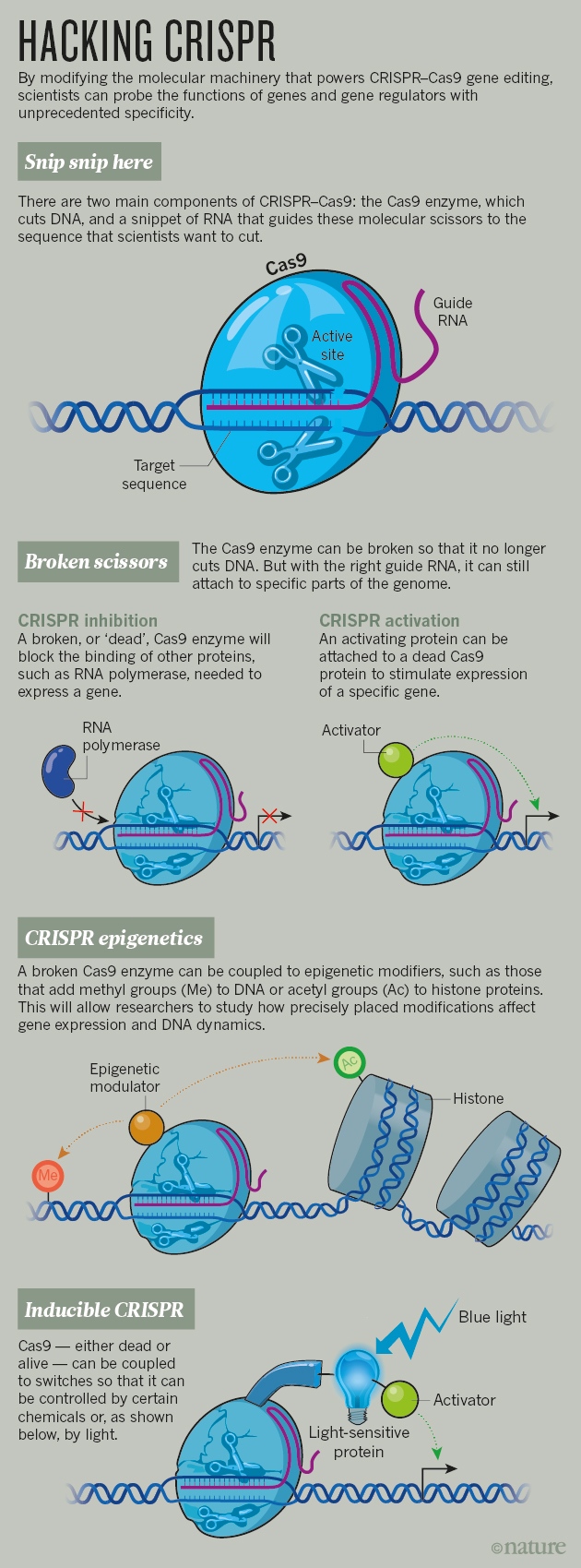
So how is the CRISPR/Cas system different? This system
relies on a short RNA molecule linked to a cutting enzyme. Which means, that
the gene targeting is done by an engineered RNA molecule, and the cutting is
done by a restriction endonuclease. By de-linking the identification and
cutting processes, the process becomes more efficient and precise. It’s like
having a skeleton key for all of those treasure-chests.
Let’s consider another analogy. Imagine a long row of
identical cars. One of these is yours. You can only find out which is yours by
using the key manually; you don’t have a remote. And every time your car is
somewhere else along the row, and you have to start from the very first car
every time. This is what traditional genetic engineering was like. The
restriction endonuclease combs the entire DNA to find the right sequence, and
starts right at one end of the DNA every time.
By contrast, the CRISPR/Cas system is like a Find and
Replace function. The RNA segment (crRNA) which you can engineer according to
your needs, binds to the target sequence. And then a separate endonuclease
accesses those sequences by looking for the RNA, without having to comb the
entire genome for that sequence. Imagine that you now have a remote key for
your car, and by simply pressing the unlock button and looking for the flashing
lights, you can find your car.
Here’s where things get exciting: scientists have started
finding ways to modify the CRISPR/Cas system to work in eukaryotic cells, to
find and replace genes of our choice. This could allow us to find and replace
defective genes with far greater precision and control. It could even allow us
to modify traits to our liking. Designer babies, anyone? Moreover, better
delivery and expression controls could allow us to alter traits in somatic
cells too.
The above explanation of CRISPR interference is simply my
attempt at explaining things in broad strokes. There are certain facts and
nuances that I’ve deliberately omitted to keep this short. But for those who’d
like to read more, here’s some extra reading material: